ADHD and Switching Tasks: Try a Simple Transition Ritual
Sheida ·
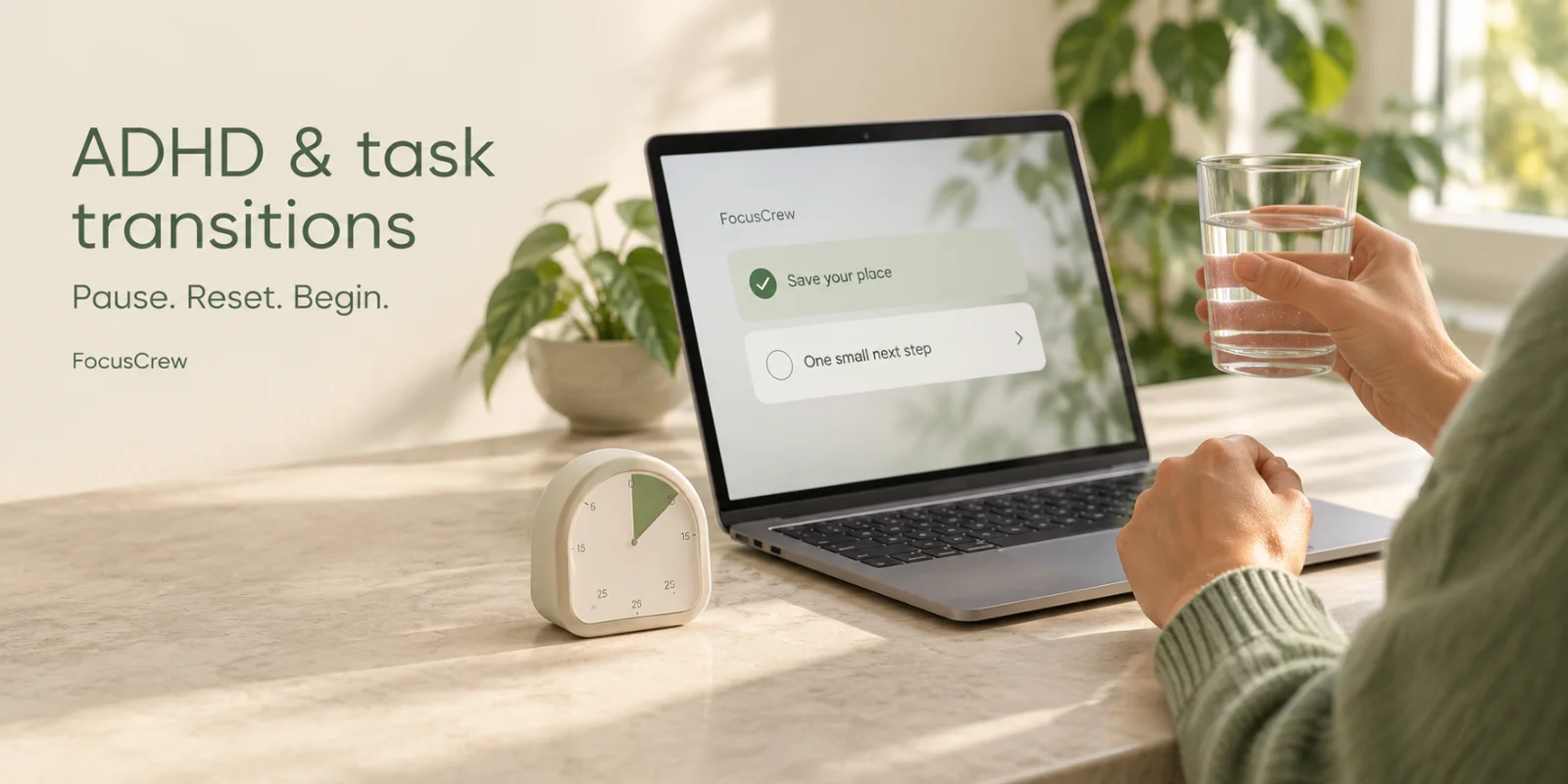
You finish a meeting, but part of your attention is still in the conversation when you open your next task. Or you end a work session and struggle to return after the break. The transition-ritual technique in FocusCrew’s ADHD Toolbox suggests using a small repeatable routine to mark the move between activities.
Research offers a reason to leave a clear return plan. Across four studies, a “ready-to-resume” intervention reduced attention residue and protected performance on an interrupting task when people anticipated time pressure on returning to unfinished work.[1] This is evidence about a particular interruption situation, not proof that every transition ritual helps ADHD. It does support experimenting with a brief note before switching.
Try a three-part sequence: save your work, write the next action, and open what you need for the next activity. A useful note might say, “Next: check the second example against the source,” rather than “finish report.” Then take a brief pause if needed. Keep the sequence short enough to use during an ordinary day, including when a switch was not your choice.
In FocusCrew, leave the unfinished work as a clear to-do and select the next task for a new focus session. The timer can mark your new commitment. You can pair that boundary with time blocking, allowing some space between activities instead of scheduling every minute back to back.
A simple cue can help you remember the routine: “When a session ends, I will save my work and name the next step.” Meta-analytic research supports this kind of if–then planning across goal-directed behaviours.[2] Keep the routine flexible and return to it after interruptions, much as you would restart a habit after a missed day. Its purpose is to make switching easier, not add another standard to fail.
References
- Leroy, S., & Glomb, T. M. (2018). Tasks interrupted: How anticipating time pressure on resumption of an interrupted task causes attention residue and low performance on interrupting tasks and how a “ready-to-resume” plan mitigates the effects. Organization Science, 29(3), 380–397.
- Gollwitzer, P. M., & Sheeran, P. (2006). Implementation intentions and goal achievement: A meta-analysis of effects and processes. Advances in Experimental Social Psychology, 38, 69–119.