How to train your focus span: what the science says

You have probably read that humans now have a shorter attention span than a goldfish: eight seconds. It is a good headline and a bad fact. The figure came from a 2015 marketing report, and when journalists went looking for the study behind it, there wasn't one. Nobody has measured a single "attention span" that shrinks or grows like a muscle.
What researchers have measured is more useful: how often we switch, how often the mind drifts, and what changes both. The short version is that focus is less like a battery you were born with and more like a skill that depends on your surroundings, your rest and the way you structure the work. That means you can train it.
How long do people actually focus?
Gloria Mark, who has studied people at work for two decades, found that the average time someone stays on one screen before switching fell from about two and a half minutes in 2004 to around 47 seconds in recent years (Attention Span, 2023). That is not a limit of the brain. It is a habit, shaped by notifications, open tabs and the feeling that something else might need us.
Even with no interruptions, the mind leaves on its own. In a study of thousands of people pinged at random moments through the day, minds were wandering almost half of the time — 46.9% — and people were less happy when they were (Killingsworth & Gilbert, 2010).
And attention fades with time on a single task. Since the 1940s, studies of "vigilance" have shown that the ability to notice things drops over long, unbroken watches. Your focus is not failing you when it dips after a while; that is how it works.
Why switching costs more than it feels
Every switch has a price. When people alternate between tasks, they are slower and make more mistakes than when they finish one first, and the cost grows with how complex the tasks are (Rubinstein, Meyer & Evans, 2001). A quick glance at a message is never just a glance: the mind needs time to load the first task back in.
Even a phone you are not using can take something. In one set of experiments, people did worse on tests of working memory when their phone was on the desk than when it was in another room (Ward et al., 2017). Later studies have found smaller effects, so treat this one as a nudge rather than a law — but moving the phone costs nothing.
Six ways to train a longer focus span
1. Start with a block you can finish
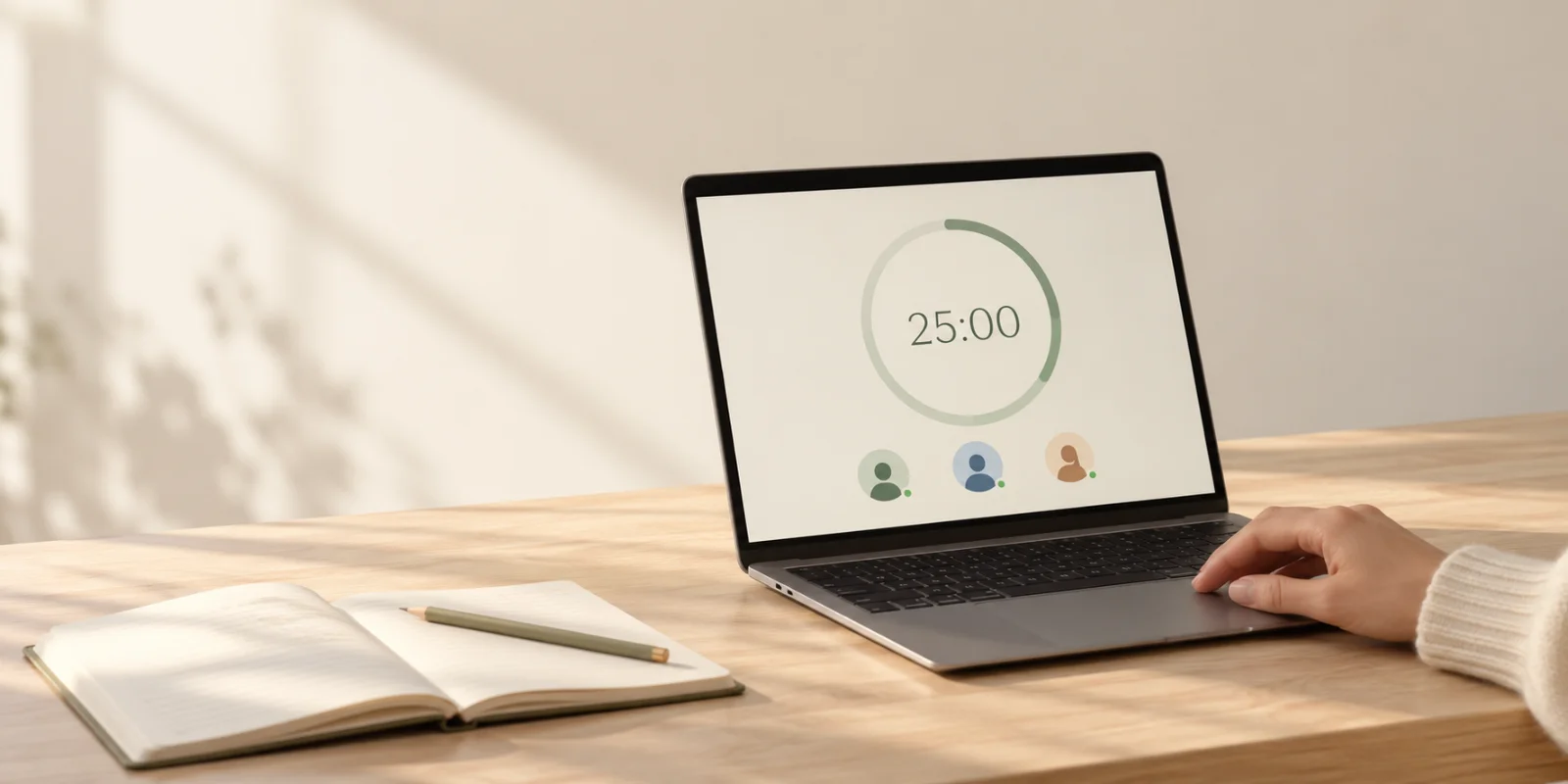
If 50 minutes feels impossible, start with 15 or 25. A focus span grows the way running distance does: by finishing a stretch you can manage and adding a little. A block you complete teaches your brain that focus ends well. A block you abandon teaches the opposite.
2. Take breaks on a schedule, not when you are exhausted
It sounds backwards, but short planned breaks protect focus. In one experiment, people who got two brief breaks during a long task kept their performance steady, while those who worked straight through declined (Ariga & Lleras, 2011). A study of students comparing timed breaks (Pomodoro-style) with breaks taken whenever they felt like it found timed breaks went with less fatigue and steadier concentration (Biwer, de Bruin & Persky, British Journal of Educational Psychology, 2023).
3. Remove the next interruption before it arrives
Close the tabs you don't need, silence notifications for the length of the block, and put the phone out of reach. Since every switch costs time to recover, the cheapest interruption is the one that never happens. Decide what you will work on before the timer starts, so you are not choosing in the middle.
4. Practise noticing when your mind wanders
Mind-wandering is normal; the skill is catching it sooner. Two weeks of short mindfulness training reduced mind-wandering and improved reading comprehension and working memory in students (Mrazek et al., 2013). You don't need a retreat: when you notice you have drifted, name it ("thinking about lunch") and return to the task. Each return is one repetition.
5. Sleep and move
Sleep loss hits attention harder than almost anything else we can measure. A large review of sleep-deprivation studies found the clearest damage was to simple, sustained attention (Lim & Dinges, 2010). Movement helps in the other direction: a meta-analysis found that a single bout of exercise gives a small, real boost to thinking skills in the hours after (Chang et al., 2012). A short walk between blocks does both jobs — it is a break and it is exercise.
6. Rest your attention in nature when you can
Attention that has been "spent" seems to recover better in calm, natural surroundings. People who walked in a park did better on a test of attention afterwards than people who walked through busy streets (Berman, Jonides & Kaplan, 2008). Even a few minutes by a window or among trees between blocks can help.
What this means if focus is hard for you
If you have ADHD, or simply find focus harder than others seem to, the same ideas apply — often more so. Short, clear blocks, breaks you plan in advance and an environment with fewer triggers are the kind of structure many people with ADHD find useful. None of this replaces advice from a doctor or therapist, and a hard day is not a sign that you have failed.
Trying it in FocusCrew
FocusCrew is built around these ideas:
- Pick a length you can finish. Start with 15 or 25 minutes and set your own length when you are ready for more.
- Breaks come on their own. With the Focus Template on, a break starts when a session ends, with a short idea to move or rest.
- Choose before you start. Pick the to-do, project or label first, so the session has one job.
- See your rhythm. Achievements → Analytics shows when your sessions tend to go well, so you can put hard work there.
The goal is not to become someone who never drifts. It is to come back a little sooner, a little more often — and to notice that your focus span is something you can grow.
Sources
- Mark, G. (2023). Attention Span: A Groundbreaking Way to Restore Balance, Happiness and Productivity. Hanover Square Press.
- Killingsworth, M. A., & Gilbert, D. T. (2010). A wandering mind is an unhappy mind. Science, 330(6006), 932.
- Rubinstein, J. S., Meyer, D. E., & Evans, J. E. (2001). Executive control of cognitive processes in task switching. Journal of Experimental Psychology: Human Perception and Performance, 27(4), 763–797.
- Ward, A. F., Duke, K., Gneezy, A., & Bos, M. W. (2017). Brain drain: The mere presence of one's own smartphone reduces available cognitive capacity. Journal of the Association for Consumer Research, 2(2), 140–154.
- Ariga, A., & Lleras, A. (2011). Brief and rare mental "breaks" keep you focused. Cognition, 118(3), 439–443.
- Biwer, F., de Bruin, A., & Persky, A. (2023). Study smart, not hard: Pomodoro technique versus self-regulated breaks. British Journal of Educational Psychology.
- Mrazek, M. D., Franklin, M. S., Phillips, D. T., Baird, B., & Schooler, J. W. (2013). Mindfulness training improves working memory capacity and GRE performance while reducing mind wandering. Psychological Science, 24(5), 776–781.
- Lim, J., & Dinges, D. F. (2010). A meta-analysis of the impact of short-term sleep deprivation on cognitive variables. Psychological Bulletin, 136(3), 375–389.
- Chang, Y. K., Labban, J. D., Gapin, J. I., & Etnier, J. L. (2012). The effects of acute exercise on cognitive performance: A meta-analysis. Brain Research, 1453, 87–101.
- Berman, M. G., Jonides, J., & Kaplan, S. (2008). The cognitive benefits of interacting with nature. Psychological Science, 19(12), 1207–1212.