FocusCrew ADHD Toolbox
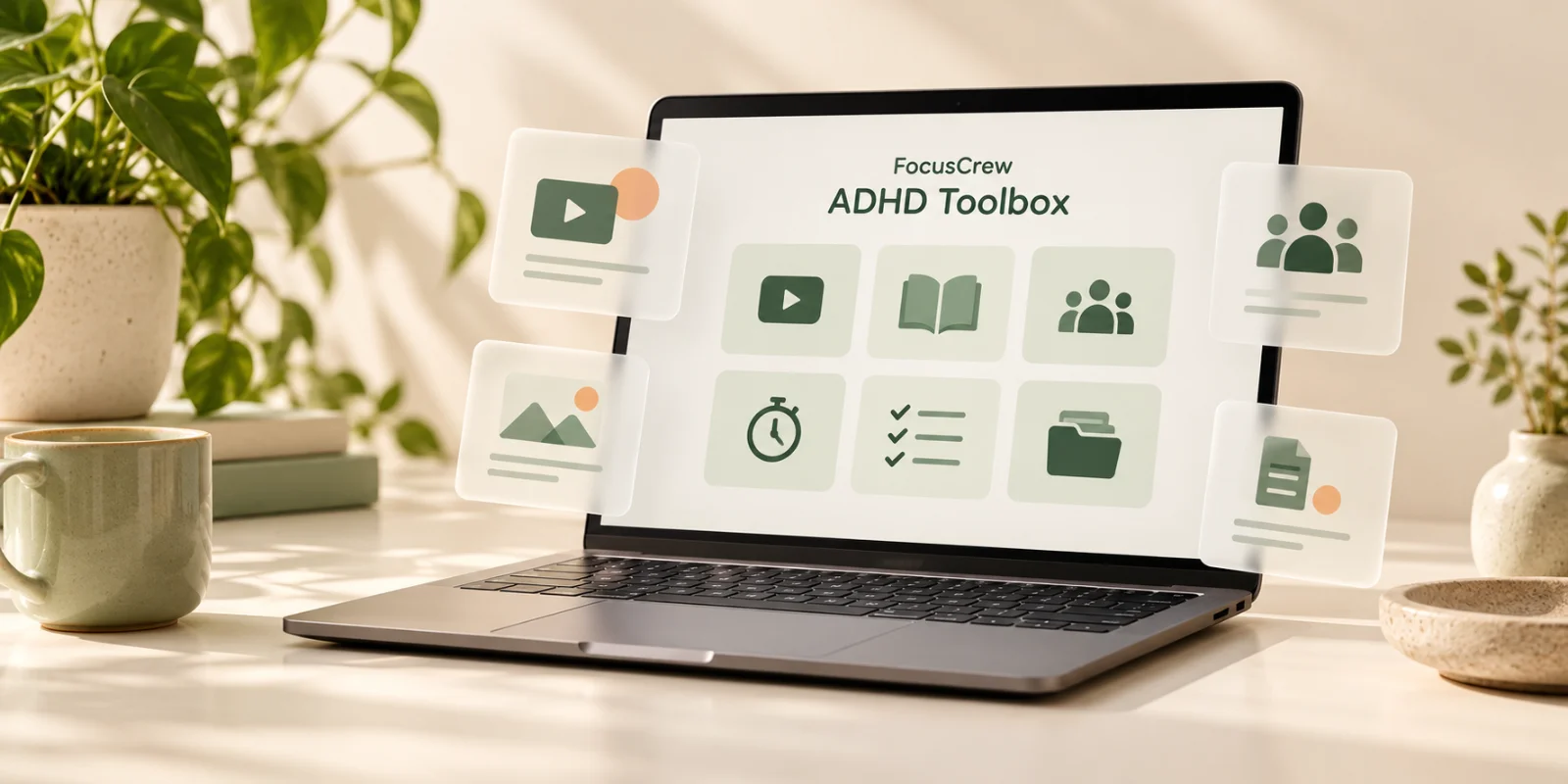
Finding useful ADHD resources can become another overwhelming task: an endless collection of tabs, advice, and things to try. The FocusCrew ADHD Toolbox brings videos, apps, communities, articles, books, courses, and practical techniques together in one place. Whether you want to understand your experiences or find a different approach to everyday work, you can start with the question that matters to you today.
One useful starting point is making work easier to organise. A randomised trial in adults with ADHD found that a structured therapy programme teaching time management, organisation, and planning improved inattention symptoms more than supportive therapy.[1] Another trial found benefits from cognitive behavioural therapy in adults who still experienced symptoms while taking medication.[2] These studies support structured skills-based treatment; they do not establish that a particular app treats ADHD. The toolbox’s practical suggestions, such as breaking tasks into concrete next actions, offer everyday strategies to explore alongside appropriate support.
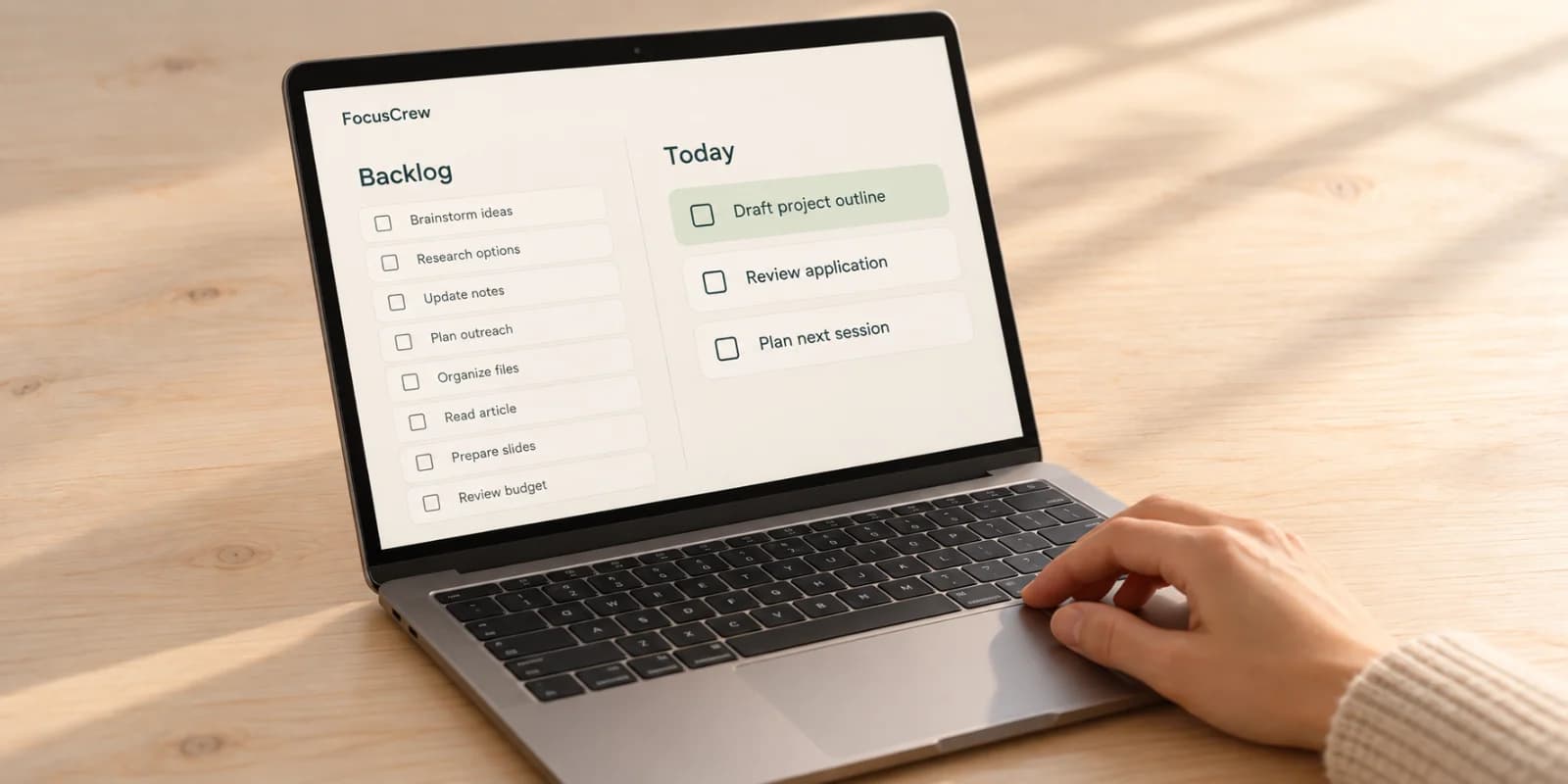
Choose one technique and try it on a real task. If “work on my application” feels too vague, make your next action “draft three sentences about my experience.” FocusCrew’s guide to choosing today’s priorities can help you narrow the list before starting. The toolbox also introduces shorter focus sprints, visible timers, and a two-minute start. In FocusCrew, you can select a to-do and begin a focus session, giving that next step a clear place in your day.
The toolbox also includes communities and resources for exploring the social side of focusing. If company appeals to you but video calls do not, camera-free body doubling introduces FocusCrew’s quieter approach. There is no camera requirement: you work on your own task, and your sessions contribute to your crew’s shared goal whenever you complete them. Try this as a personal experiment in accountability, rather than assuming it will work the same way for everyone.
You can also explore the toolbox’s short self-check to reflect on attention, restlessness, and their impact on daily life. It is not a diagnosis and cannot confirm or rule out ADHD; a qualified clinician can assess persistent difficulties. You do not need to read every resource or adopt every technique to begin. Open the ADHD Toolbox, choose one relevant resource, and use it to make one next step more manageable.
References
- Solanto, M. V., Marks, D. J., Wasserstein, J., Mitchell, K., Abikoff, H., Alvir, J. M. J., & Kofman, M. D. (2010). Efficacy of meta-cognitive therapy for adult ADHD. American Journal of Psychiatry, 167(8), 958–968. https://doi.org/10.1176/appi.ajp.2009.09081123
- Safren, S. A., Sprich, S., Mimiaga, M. J., Surman, C., Knouse, L., Groves, M., & Otto, M. W. (2010). Cognitive behavioral therapy vs relaxation with educational support for medication-treated adults with ADHD and persistent symptoms: A randomized controlled trial. JAMA, 304(8), 875–880. https://doi.org/10.1001/jama.2010.1192